
Founded in 1986, Liberty Counsel Action is a law and policy education, training and advocacy organization. From offices in Washington, DC and Orlando, Florida, LCA advances religious freedom, the sanctity of human life, the family, responsible government, national security, and support for Israel at the federal, state, and local levels. All contributions are made with the understanding that this ministry has complete discretion and control over use of donated funds. If the project described is fully funded, delayed or canceled, excess funds will be committed to the need most closely identified with the purpose for which the funds were originally given. Liberty Counsel Action is a 501(c)(4) tax-exempt nonprofit organization. Donations are not tax deductible. Privacy Policy.
Advancing Life and Liberty Through Action
While the official comment period has closed, there are many other ways to take action. To get involved, download our Toolkit, see our Fax Campaign, and sign our petition!

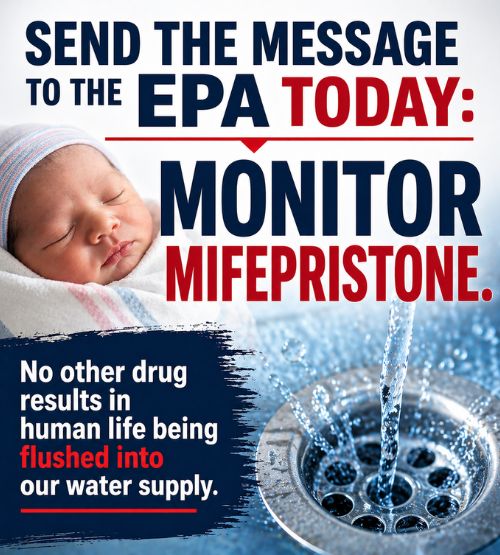
URGENT ACTION ALERT: Ask Government Officials to regulate chemical abortion drugs in our water. It only takes 60 seconds.
The Environmental Protection Agency (EPA) just opened a unique comment period for the sixth Drinking Water Contaminant Candidate List (CCL 6). Given the likely contamination of our water caused by the abortion pill mifepristone – the only drug that was designed and approved by the FDA to intentionally end a pre-born life – it, and its active contaminating components, need to be on the CCL 6 list of things polluting our water.
This contaminant candidate list is currently a "draft" - meaning your input can make a big difference to the final version!
The comment period is only open until June 5th. Join us in convincing the EPA to list the abortion drug mifepristone as a water contaminant by submitting a comment today!
-
For answers to frequently asked questions, click here.
-
To submit a concise, pre-prepared comment (60 SECOND OPTION), click here.
-
To submit a more comprehensive, pre-prepared comment (60 SECOND OPTION), click here.
-
To submit your own, unique comment utilizing our "Top 20" reasons to place mifepristone on CCL 6, click here.
-
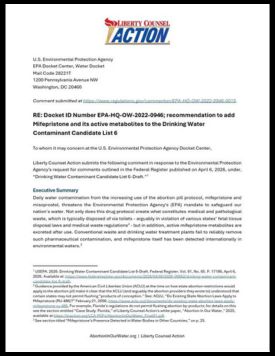
To read Liberty Counsel Action's comment, click here.
While any action will make an impact, comments reflecting unique perspectives are particularly powerful. As the federal government outlines, agencies “must respond to relevant and significant comments,” and “the perspective of individual persons” is especially valuable!
Submit a concise pre-prepared comment
Click here to send the comment below to the EPA's Office of Water today*!
Subject line (Docket Number Required): Re: Docket ID Number EPA-HQ-OW-2022-0946 – urgent need to add mifepristone & its active metabolites to CCL 6
Dear Mr. Lombardi and officials at the Environmental Protection Agency Docket Center,
I write in response to the draft Contaminant Candidate List 6 (CCL 6), Docket ID No. EPA-HQ-OW-2022-0946, and respectfully request that mifepristone and its active metabolites be added to the final CCL 6. As traditional waste and drinking water treatment systems were not designed to fully remove pharmaceutical contaminants, there is reason to believe these compounds may be entering U.S. water supplies and drinking water.
This is concerning because mifepristone acts as an endocrine disruptor that blocks progesterone, a vital fertility hormone for men, women, and animals. Other known endocrine-disrupting chemicals can harm fertility and development even if ingested at low levels over time. In addition, chemical abortion produces fetal remains and medical waste that typically enters wastewater systems. These remains and waste can contribute to clogs and sewer system overflows, as they do not break down like feces or toilet paper, creating an additional environmental question that EPA should evaluate.
Because no comprehensive studies appear to have evaluated chronic low-dose exposure to mifepristone through drinking water, it is prudent to treat mifepristone and its active metabolites as contaminants of concern and to study whether they, and the aborted fetal remains and medical waste they create, present public health risks. Given the scale of chemical abortion use and the lack of clear EPA monitoring for these compounds, I respectfully urge EPA to list mifepristone, CAS number 84371-65-3, and its active metabolites on the final CCL 6. I likewise urge the EPA to begin monitoring and research on them to determine contamination levels and any needed risk-reduction measures.
Thank you for your time and consideration.
Click here to send the comment below to the EPA's Office of Water today*!
Subject line (Docket Number Required): Re: Docket ID Number EPA-HQ-OW-2022-0946 – urgent need to add mifepristone & its active metabolites to CCL 6
Dear Mr. Lombardi and officials at the Environmental Protection Agency Docket Center,
I am writing in response to the call for comments on the draft Contaminant Candidate List (CCL) 6, Docket ID Number EPA-HQ-OW-2022-0946.
The EPA’s CCL 6 presents a unique and time-sensitive opportunity to enhance the safety of American drinking water. For the following reasons I respectfully request that the synthetic abortion drug mifepristone and its active metabolites be added to the final CCL 6:
1. There is strong reason to believe Americans may be ingesting mifepristone and its active metabolites in drinking water. After being consumed, mifepristone is broken down into biologically active metabolites that retain significant ability to block the vital fertility hormone progesterone. These compounds are excreted in urine and feces and can be present in the blood and aborted fetal tissues that women expel, which are then typically flushed into wastewater systems. EPA and multiple scientific reviews acknowledge that conventional waste and drinking water treatment plants were not designed to completely remove these types of pharmaceutical contaminants. Indeed, numerous pharmaceuticals have been repeatedly detected in treated wastewater, surface waters, and even finished drinking water.
Furthermore, studies from other countries have already detected mifepristone itself in hospital wastewater discharge, municipal wastewater, and rivers, making it reasonable to conclude there is a substantial likelihood similar contamination is occurring in U.S. waters.
2. Ingestion of mifepristone and its metabolites is likely to have an adverse effect on human health, particularly because these chemical compounds act as endocrine disruptors: Mifepristone is designed to block progesterone, a hormone essential to normal reproductive function in women, men, and animals. EPA and leading scientific bodies have already raised concerns that potential endocrine-disrupting chemicals—including at very low concentrations over time—can interfere with hormones, impair fertility, and contribute to developmental and reproductive problems, especially for sensitive groups like pregnant women, their developing infants, and children.
Given that mifepristone is a strong progesterone blocker and that no comprehensive studies have evaluated the possible effects of chronic, low-dose exposure through drinking water, it is prudent and consistent with EPA’s public health mission to treat this drug and its metabolites as contaminants of concern that merit placement on CCL 6 and targeted research.
3. The physical and chemical properties of mifepristone amplify these concerns. Mifepristone is a synthetic steroid that is not readily biodegradable and has a relatively long half-life, characteristics associated with a greater potential to persist and to bioaccumulate in aquatic organisms over time. Specifically, it has been indicated that mifepristone degrades slowly in the environment. Furthermore, experimental studies in aquatic species (such as sea urchins, fish, and frogs) have already shown adverse effects on fertility, development, and reproductive biology (including at least one study which researched mifepristone's impact at environmentally relevant concentrations).
The combination of slow degradation, ongoing input from hundreds of thousands of chemical abortions each year, and demonstrated endocrine activity justifies placement by name on the CCL 6 rather than as part of an overly-broad pharmaceuticals category containing thousands of drugs.
4. Mifepristone is unique among all other pharmaceuticals in that it is the only one intentionally developed and approved by the Food and Drug Administration (FDA) to end a human life in the womb and generate fetal remains and medical waste (which, as noted, are most frequently disposed of through toilets). These remains and medical waste may contribute to sewer system overflows, yet mifepristone's environmental fate and potential health impacts were never rigorously evaluated before its approval by the FDA. Adding mifepristone and its active metabolites to CCL 6 would give the EPA a concrete and meaningful opportunity to begin addressing this information and research gap.
In light of rising infertility, growing national concern about endocrine disruptors, and the President’s stated commitment to “crystal clean drinking water,” I respectfully urge the EPA to list mifepristone (CAS Registry Number 84371-65-3) and its active monodemethylated, didemethylated, and hydroxylated metabolites on the Final CCL 6 and initiate robust monitoring and research to determine the extent of contamination and any necessary risk reduction measures needed in order to reduce potential health harms.
Thank you for your attention to this matter.
Create your own comment!
To submit your own, unique comment*:
-
Select your favorite reasons to add mifepristone to CCL 6 from our "Top 20" list below and paste them into an email.
-
See our example introductory and concluding remarks and write your own version.
-
Include your name and contact information at the end of the email in case the agency has questions.
-
Copy and paste the following Docket number into your subject line: Docket ID Number EPA-HQ-OW-2022-0946. Very important to include the Docket ID!
-
Send the email to [email protected].
-
Post our webpage on your social media and encourage others to submit as well!
Note: Alternatively, you can submit comments at https://www.regulations.gov/commenton/EPA-HQ-OW-2022-0946-0015, which is the EPA's preferred method. To do so:
-
Copy your favorite reasons from below and paste them into the "Comment" section.
-
Follow all the instructions on the page and be sure to fill out each relevant field. Note: There is a reCAPTCHA.
-
Click submit.
Subject: Regarding Docket ID Number EPA-HQ-OW-2022-0946
Introduction: Summarize in your own words why you believe mifepristone and its active metabolites need to be placed on CCL 6. For example:
Dear Mr. Lombardi and officials at the Environmental Protection Agency Docket Center,
I am writing today as a (mother / father / student / concerned citizen) regarding the potential health hazard posed by mifepristone contamination in our water supply. While there are numerous reasons to ensure mifepristone and its active metabolites are placed on the EPA’s final CCL 6, I would like to highlight the following:
Body: Select your top reasons from among the following "Top-20 Reasons to Place Chemical Abortion Pill Contaminants on CCL 6" (copy and paste a mix of these):
-
Mifepristone and its active metabolites meet all the Safe Drinking Water Act requirements for being placed on the CCL, as well as all three criteria for regulation: they may harm health, they are likely to occur in public water systems, and doing so offers a meaningful opportunity for risk reduction if regulated.
-
Mifepristone’s biologically active metabolites, which retain significant ability to block progesterone, are daily entering our water supply as wastewater systems are unable to fully remove these sorts of contaminants (said metabolites enter wastewater systems via excretion and the medical waste expelled from terminated pregnancies - aborted human fetuses, placentas, etc.).
-
Multiple international studies have documented pharmaceuticals persisting in treated wastewater, surface waters, and finished drinking water.
-
Mifepristone itself has been detected in in other developed countries in hospital wastewater, wastewater treatment plant effluent, and rivers, showing it can survive common treatment processes and reach natural water bodies.
-
Mifepristone is a progesterone blocking endocrine disruptor, suggesting long-term low dose exposure to it and its active metabolites through drinking water could impair fertility and reproductive health in both women and men.
-
The Environmental Protection Agency and leading scientific bodies warn that potential endocrine disrupting chemicals (like mifepristone and its metabolites) in drinking water—even at very low levels—can alter hormonal process, negatively impacting development and reproduction, especially in vulnerable groups like pregnant women, infants, and children.
-
No comprehensive U.S. monitoring has ever been done on mifepristone, nor have toxicological studies ever evaluated chronic exposure to possible trace levels of mifepristone and its active metabolites in drinking water, which is exactly the type of data gap placement on the CCL 6 could help to address.
-
Mifepristone is a synthetic steroid that is not readily biodegradable – rather, it degrades slowly in the environment - raising concern that it may qualify as a “pseudo-persistent” environmental contaminant with the potential for bioconcentration in aquatic life.
-
Available data suggest mifepristone has a potential to bioaccumulate, which means it could build up in fish and other wildlife.
-
Because mifepristone and its metabolites are continuously introduced into the environment, they may behave as “pseudo persistent” contaminants, maintaining steady levels in water that may be harmful to humans and animals.
-
Laboratory studies in aquatic species (such as sea urchins, fish, and frogs) show that mifepristone exposure can reduce normal fertility and disrupt normal development.
-
Since its original approval in 2000, drug-induced abortion has continually trended upward and now accounts for the majority of the over 1-million U.S. abortions that occur annually, meaning the amount of mifepristone and its active metabolites entering wastewater each year is large and steadily increasing.
-
Mifepristone is unique among FDA approved pharmaceuticals: It is the only one designed to be lethal to an unborn child and produce medical waste (aborted fetal remains, placenta, etc.), which is frequently disposed of via toilets, creating an additional, unassessed pollutant stream – particularly concerning given the likelihood that such remains comprise at least a portion of the billions of gallons of contaminated combined sewer overflow (including raw sewage) that are estimated to be annually discharged into U.S. waterbodies.
-
The (original and only U.S.) 1996 environmental assessment for mifepristone relied on an estimate of the amount of mifepristone that would be found in the water, leading the FDA to issue a “finding of no significant impact” instead of doing a full environmental impact statement. This left major questions about water quality (how much mifepristone is in our water, and whether it can harm us) unresolved – questions that have become even more relevant as the use of mifepristone has increased dramatically since then.
-
The EPA has previously acknowledged that pharmaceuticals in water may cause hormone disruption and other subtle, long term effects, even when individual compounds are present at low concentrations.
-
Adding mifepristone and its active metabolites to CCL 6 could serve as a vital first step in triggering the type of systematic occurrence monitoring, exposure assessment, and health effects research that is currently missing but urgently needed.
-
Mifepristone clearly qualifies as a candidate for a National Primary Drinking Water Regulation (NPDWR). Listing it now on CCL 6 helps the EPA meet its obligation to identify and prioritize such contaminants for future development of an NPDWR.
-
Placing mifepristone on CCL 6 would serve as a vital step to correcting historic regulatory oversights under the National Environmental Policy Act (NEPA) and the Clean Water Act (CWA), where biological (fetal remains) and chemical (pharmaceutical) waste from drug-induced abortions were not adequately considered in the federal decision making process that led to the approval of the chemical abortion pill protocol.
-
Growing national concern about declining fertility, combined with federal initiatives recommending study on endocrine disruptors and pharmaceuticals in water, make it especially important to investigate whether trace amounts of progesterone blockers like mifepristone and its active metabolites are contributing to this trend.
-
Given the drug’s unique lethal nature, endocrine disrupting action, environmental persistence, and growing use, treating mifepristone and its metabolites as ordinary, unlisted pharmaceuticals is no longer scientifically or ethically defensible, and explicit listing on CCL 6 rather than including it as part of a broad "pharmaceutical group" is an appropriate and needed first step toward regulation.
Conclusion: Rephrase the introduction in your own words. For example:
The above reasons demonstrate the potential harm caused by contamination from the chemical abortion pill mifepristone and its active metabolites in our water. As someone who drinks water every day, I respectfully request the EPA urgently add these contaminants to CCL 6.
Thank you for your attention to this matter.
RE: Docket ID Number EPA-HQ-OW-2022-0946; recommendation to add Mifepristone and its active metabolites to the Drinking Water Contaminant Candidate List 6
1. What is the Contaminant Candidate List (CCL)?
The CCL is “a list of drinking water contaminants that are known or anticipated to occur in public water systems and are not currently subject to EPA drinking water regulations.”
“Contaminants” is defined to encompass chemical substances — which includes human drugs, like mifepristone.
2. Why should mifepristone and its metabolites be on CCL 6?
To summarize from LCA's own comment and the above "Top-20 Reasons to Place Chemical Abortion Contaminants on CCL 6":
It is highly likely mifepristone and its active components are entering public water systems via wastewater from widespread home use as most waste and drinking water treatment infrastructure is not designed to remove this class of contaminants.
Mifepristone and its active metabolites may pose endocrine disruption (interfering with a body’s natural hormonal processes) risks in wildlife and humans. Specifically, the abortion drug mifepristone blocks a vital fertility hormone, progesterone, and its active metabolites likely retain this ability after excretion and entering our water systems. Combine with point 1 – that conventional water treatments are not designed to remove these sorts of contaminants – this means American drinking water could be contaminated with trace levels of a hormone-blocking substance. This could affect animal and human fertility or reproductive systems, regardless of sex.
There is a lack of updated environmental data relative to the current level of mifepristone usage. Specifically, the last known U.S. environmental review for mifepristone dates back to a 1996 environmental assessment. The study itself was entirely inadequate even at the time, and now it is woefully outdated and arguably irrelevant given that the use of the chemical abortion pill protocol has increased dramatically since its approval– from a mere 6 percent in 2001 to now encompassing vast majority of abortions (approximately 70 percent).
Ecological impacts are unknown and potentially significant. Specifically, wildlife toxicology studies involving mifepristone show:
Reduced fertility and abnormal embryo development in sea urchins
Sex reversal effects in fish after prolonged exposure
Altered progesterone receptor expression in frogs, with potential reproductive effects.
These effects in wildlife suggest possible parallel impacts on humans exposed chronically through drinking water.
The EPA’s past CCL lists (such as this one) have included pharmaceuticals, endocrine disrupting chemicals, and synthetic compounds. Mifepristone falls into all three categories.
While the current Draft CCL 6 includes a "pharmaceutical group", given the likelihood the mifepristone would be overlooked among the thousands of other drug compounds (that is, the EPA is unlikely to choose to monitor or study it), it needs to be placed by name on CCL 6 to ensure it is given proper consideration for research, monitoring and regulation.
In short, mifepristone and its active metabolites present one of the greatest health risks of our time. Not only should mifepristone and its active metabolites be on the CCL 6 – we believe they should be among those contaminants the EPA ultimately regulates.
(Note: Ultimately, we propose that the “polluter pays” model be utilized with any regulation related to mifepristone. In other words, the wastewater treatment plants that would be testing their waters to determine the level of mifepristone present should not be paying to mitigate the pollution caused by the pharmaceutical companies and abortion industry advocates that championed the abortion pill- the abortion industry should pay.)
3. If mifepristone and its metabolites are placed on the CCL 6, what happens next?
The Environmental Protection Agency (EPA) evaluates contaminants on this list to determine which carry significant enough health risk to merit regulation (of note, it is ultimately up to the Administrator to determine whether "regulation of the contaminant presents a meaningful opportunity for health risk reductions for persons served by public water systems"). Related, the EPA may determine occurrence monitoring data is needed and include it in the Unregulated Contaminant Monitoring Rule (UCMR), and/or determine other, further research is needed.
All would be major victories.
4. Will lives be saved / is this pro-life?
Bringing attention to the environmental harm caused by the chemical abortion pill has huge potential to save lives. Asking the EPA to place it on CCL 6 specifically has the potential to lead to further research and regulation. Though ultimately it should be prohibited, if it is not, and if it is regulated as it should be – by, for example, requiring women remain in a clinic for an abortion, or at the least, require they collect the fetal remains for proper disposal – it will certainly save lives.
Additionally, even for those that are not pro-life, environmental safety is also pro-common sense!
5. Will my action actually make a difference?
YES! The federal government itself states: "An important way for Americans to influence the policies impacting their lives is by interacting directly with federal agencies on the regulations those agencies create. Federal law generally provides organizations and individuals with opportunities to comment on agencies’ proposed regulations."
Indeed, though usually we think of "laws" as being passed by Congress, many of our nations' legal requirements are actually "regulations" or "rules" issued by agencies – like the Environmental Protection Agency – not laws passed by Congress. Even so, "Regulations, like statutes passed by Congress, are law . . . Regulations can establish significant policies and requirements for individual citizens, state and local governments, small businesses, and organizations large and small."
Hence, we encourage you to either use our tool to submit a pre-drafted concise or detailed comment, or submit your own unique comment to the EPA.
If you would like to sign up for more Liberty Counsel Action alerts, subscribe here: https://lcaction.org/subscribe
*Please be aware the EPA may publish your comment online to https://www.regulations.gov, including any personal information provided, and "once submitted, comments cannot be edited or removed from the docket. . . Do not submit electronically any information you consider to be Confidential Business Information (CBI) or other information whose disclosure is restricted by statute." For more information, see the “Public Participation” heading of the SUPPLEMENTARY INFORMATION section available at https://www.federalregister.gov/documents/2026/04/06/2026-06662/drinking-water-contaminant-candidate-list-6-draft.
Other methods of submission:
By Mail to: U.S. Environmental Protection Agency
EPA Docket Center
Docket ID Number EPA-HQ-OW-2022-0946, Water Docket, Environmental Protection Agency
Mail code: 28221T
1200 Pennsylvania Ave. NW
Washington, DC 20460Hand deliver/Courier to: EPA Docket Center, WJC West Building, Room 3334, 1301 Constitution Ave. NW, Washington, DC 20004. The Docket Center's hours of operations are 8:30 a.m.-4:30 p.m., Monday through Friday (except Federal Holidays).
For more information on the CCL 6-Draft Comment period, see: https://www.federalregister.gov/documents/2026/04/06/2026-06662/drinking-water-contaminant-candidate-list-6-draft.
Liberty Counsel Action
PO Box 540629
Orlando, FL 32854
407-875-1789
[email protected]
Privacy Policy
©Copyright 2010 - present. All Rights Reserved.
Orlando, FL 32854
407-875-1789
[email protected]
Privacy Policy
©Copyright 2010 - present. All Rights Reserved.